Key Takeaways
- Purple can symbolize transformation, dignity, mystery, and emotional depth in poetry.
- Butterfly symbolism in poetry often represents growth, renewal, and personal change.
- Color symbolism in literature gives ordinary images deeper emotional meaning.
- Symbolic poetry books allow readers to interpret transformation through their own experiences.
- Purple and butterfly imagery together can represent self-discovery, healing, and becoming more confident.
How is it that one color can give poems an extra element of feeling, mystery, or meaning? In poems, there are instances where the colors themselves hold more than just their physicality. Purple itself has been a symbol for royal authority, spirituality, mystery, and emotion.
Purple Symbolism in Poetry is hence especially intriguing since poets explore such concepts as transformation, identity, and growth. The use of purple together with imagery of butterflies indicates that there is transformation from one phase of life to another.
What Is the Meaning of Purple in Poetry?
The meaning of “purple” in poetry has various interpretations. Traditionally, purple symbolized wealth and royalty since it is difficult to produce this color. However, in poetry, the meaning of purple may also relate to spirituality, sadness, imagination, or a supernatural and mystifying aspect.
For poets, this gives purple a wide emotional range. It can represent:
- Inner strength and dignity
- Mystery and imagination
- Spiritual reflection
- Emotional depth
- Individuality
- Personal transformation
The surrounding imagery usually determines which meaning becomes most important.
Purple as a Symbol of Transformation
Transformation doesn’t occur instantly. It may be characterized by some uncertainty, tragedy, introspection, and growth.
The color purple is ideal for the described setting, as it evokes many contradictory meanings. It can be a sign of strength and weakness, beauty and enigma, an old identity and a new identity.
It explains why many poems about transformation employ symbols such as colors, flowers, seasons, nature, etc. It doesn’t mean that one tells readers about the change; it means that one allows readers to see it.
How Color Symbolism Works in Literature
Colors are used by writers to set moods, bring out emotions, and yet again add a new dimension to their storylines. A certain color can keep cropping up in order to link different scenes or portray changes in the emotions of a character.
The color purple is very versatile in its application in literature. It symbolizes royalty and power, but in the sense of certain literary points of view, it symbolizes spirituality, sadness, and the supernatural.
This is the strength of color symbolism in literature. There is no set guideline that says purple always means one thing.
Purple and Inner Strength
Due to the fact that for centuries purple represented respect and strength, poets can use this color to indicate a person’s self-respect.
Instead of representing social class, the color purple can be used by poets to denote the time when a person starts to appreciate his worth.
Thus, purple becomes the color of self-appreciation and self-esteem.
Purple and Emotional Complexity
Purple can also represent complicated emotions. Its associations are not limited to happiness or sadness, making it suitable for poetry about experiences that contain several feelings at once.
Think about heartbreak. One may experience feelings of love, rage, sorrow, nostalgia, and hope at the same time. The purple symbolism unites these feelings in one color without simplifying them to one feeling.
That makes it particularly relevant to poetry about healing and personal change.
Butterfly Symbolism in Poetry
Among all images of nature that represent change, nothing would fit more than that of a butterfly.
The transformation from caterpillar to butterfly represents change, growth, and creation. The butterfly transformation also is a slow process; hence, it represents change in humans.
The butterfly symbolism in poetry may be one of leaving behind an old self and becoming something new and clear.
The butterfly does not erase its earlier stages. Each stage is necessary for the next one.
Human growth can work in much the same way.
Purple and the Butterfly Together
If purple and butterflies occur simultaneously, there is more depth to their symbolism.
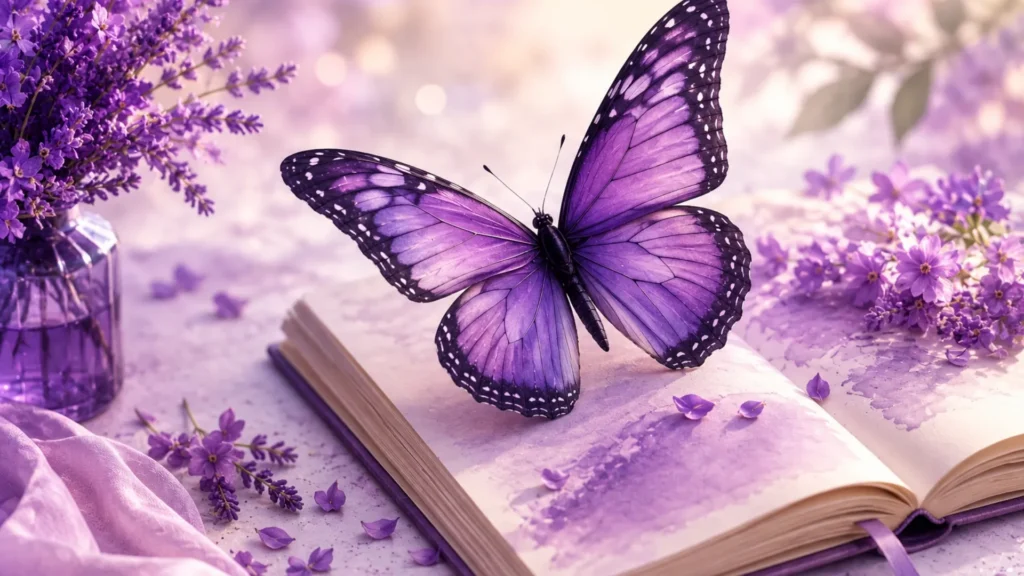
Butterflies symbolize change, whereas the color purple can include dignity, uniqueness, mysticism, depth, and power. Thus, together they may symbolize a personal transformation.
The image might represent:
- Moving beyond emotional pain
- Discovering personal identity
- Developing confidence
- Accepting change
- Becoming more authentic
The symbolism remains open enough for every reader to connect it with their own experiences.
Penelope’s Purple Passions: The Emergence of the Butterfly
Penelope’s Purple Passions: The Emergence of the Butterfly by Penelope Chaisson offers a natural example of these ideas.
The butterfly is employed as a major metaphor for the processes of love, emotions, and development in the collection. The book has been critically analyzed to have the four sections structured around the stages of metamorphosis of a butterfly, which eventually leads to self-assurance and self-awareness.
The butterfly therefore becomes more than an image. It represents the process of becoming.
Purple adds another possible layer of interpretation. Its associations with power, individuality, mystery, and emotional complexity complement the butterfly’s movement toward transformation.
Together, these symbols suggest that personal growth is not about becoming someone completely different. It can be about becoming more fully yourself.
Why Symbolic Poetry Feels Personal
One reason symbolic poetry books can stay with readers is that they do not always provide one fixed interpretation.
A butterfly could be interpreted as freedom by one reader while being healing by another reader. Purple could be viewed as a color that connotes confidence by one reader and could mean mystery or spirituality by another.
This makes it possible for people to interpret poetry according to their own experiences.
It is also the reason why the same poem means something different at different stages in life due to changing experiences.
How to Notice Symbolism While Reading
The next time you encounter a strong color or natural image in a poem, ask:
- Why did the writer choose this image?
- Does it appear more than once?
- What emotions surround it?
- Does its meaning change?
- Is it connected to a moment of transformation?
Such questions could uncover aspects that may go unnoticed by default.
What is more, never limit yourself to a single interpretation. Good symbolism allows for both the author’s intentions and the reader’s experience.
Final Thoughts
Purple symbolizes a lot more besides beauty. It can symbolize dignity, mystery, spirituality, depth of emotion, uniqueness, and change. When combined with the imagery of a butterfly, it takes on the special significance of a transformative nature.
Penelope’s Purple Passions: The Emergence of the Butterfly illustrates how these symbols may come together through a poetic experience of love and self-discovery.
At the end of the day, however, the most potent symbolism is that which does not instruct readers how to feel but leaves the interpretation up to them.
FAQs
What meanings can be attributed to the color purple in poetry?
It may be associated with dignity, individuality, mystery, spirituality, emotion, and metamorphosis. However, its meaning is contextual within the scope of poetry.
What meaning does a butterfly have as a symbol of transformation?
It is a natural image of transformation since it symbolizes change, growth, renewal, and emergence.
In what way is symbolism by colors enriching for poetry?
This device can evoke emotions in the reader as well as give him extra information about something that is being described indirectly.
What is the topic of the collection “Penelope’s Purple Passions: The Emergence of the Butterfly”?
The collection uses a butterfly’s life cycle to explore love, self-discovery, transformation, and self-worth.